
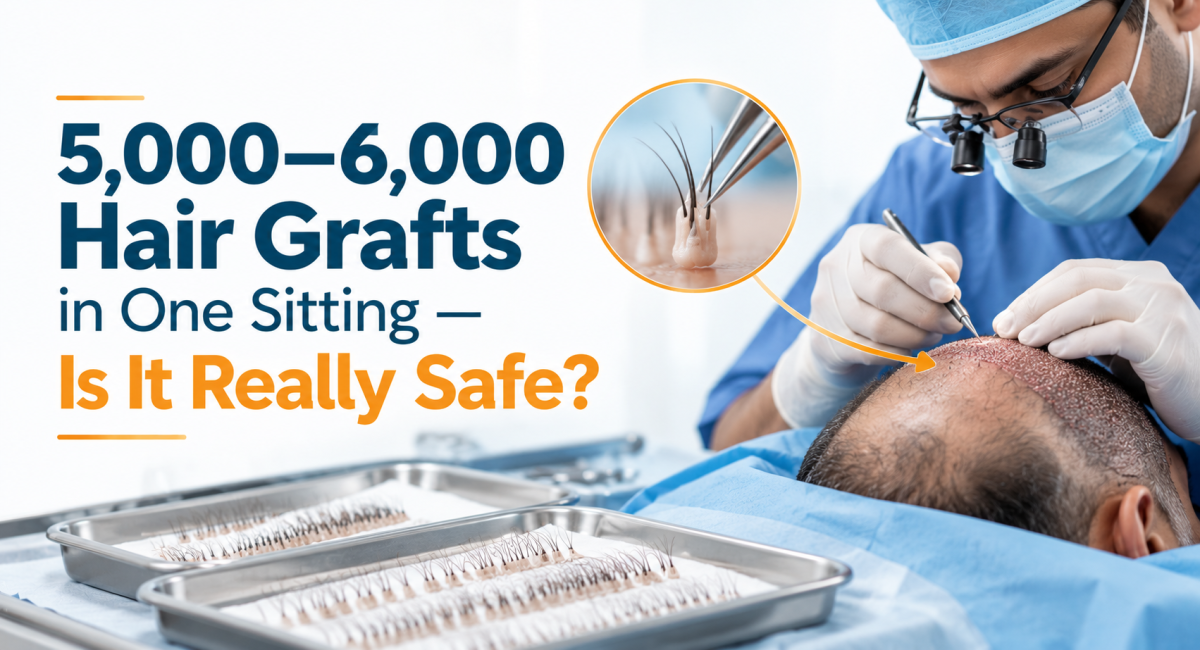
5,000–6,000 Hair Grafts in One Sitting — Is It Really Safe?
Before being impressed by a promise of 5,000 or 6,000 FUE grafts, ask one important question: How many grafts does your donor area actually contain?
Today, some hair transplant centres advertise 5,000–6,000 grafts in a single sitting, making patients believe that more grafts automatically mean better results.
But is harvesting such a large number always safe? And what happens to the remaining hair in your donor area?
1. Your Donor Hair Is Limited — Understand the Mathematics
The permanent donor area, situated mainly at the back and sides of the scalp, contains a limited number of follicular units (grafts).
For illustration, consider a patient with 10,000 follicular units in the donor area.
| Grafts extracted | Percentage removed |
|---|---|
| 2,500 | 25% |
| 3,500 | 35% |
| 5,000 | 50% |
| 6,000 | 60% |
Would you really want to remove 50–60% of your available donor grafts in a single sitting?
Excessive FUE harvesting can permanently reduce donor density, cause visible thinning or patchiness, and limit future hair transplantation.
2. What Does Scientific Research Say?
A published Indian study involving 580 men assessed the number of follicular units available in different donor zones.
Using a conservative 25% extraction approach, researchers estimated approximately:
2,064 grafts from a limited donor zone.
3,097 grafts from a standard donor zone.
3,612 grafts from an extended donor zone.
The authors recommended harvesting approximately 25% in the first sitting, with further extraction considered in selected patients after adequate recovery.
Importantly, the extended donor area may not remain permanently resistant to future hair loss.
These figures are population estimates, not fixed limits for every patient.
3. What Happens When Too Many Grafts Are Harvested?
FUE does not create new hair follicles. It simply transfers existing follicles from the donor area to the bald area.
Once a follicular unit is completely removed, it does not regenerate as a new follicular unit in its original location.
Overharvesting may result in:
Permanent thinning of donor hair.
Patchy, unnatural appearance at the back of the scalp.
Increased risk of damage to surrounding follicles.
Insufficient donor hair for future transplantation.
Remember: A successful hair transplant should improve the bald area without unnecessarily damaging the donor area.
4. What Should You Ask Before Agreeing to 5,000–6,000 Grafts?
Ask your surgeon:
“Doctor, have you measured my donor-area density and estimated the total number of follicular units available? What percentage do you plan to extract, and how will my donor area look afterward?”
A responsible surgeon should consider donor density, hair thickness, future hair loss, and the long-term appearance of both donor and recipient areas before recommending the graft count.
Harvesting 5,000–6,000 grafts may be possible in carefully selected patients, sometimes over multiple sessions. However, such numbers should never be promised routinely without assessing individual donor capacity.
Final Message: More Grafts Do Not Always Mean a Better Hair Transplant
Your donor hair is a limited, irreplaceable resource.
The aim of hair transplantation should not be to harvest the maximum number of grafts, but to achieve natural coverage while preserving sufficient donor hair for the future.
Before agreeing to 5,000–6,000 grafts, don’t just ask, “How much hair will I gain?”
Ask, “How much of my precious donor hair will I lose?”